
Ludwig Mies van der Rohe
Defining Modern Architecture in Portland From Afar
by Brian Enright
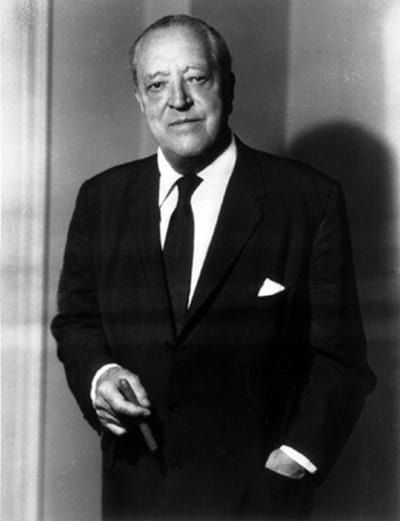
Ludwig Mies van der Rohe stands as one of the most influential architects of the twentieth century. He was a visionary whose radical belief in clarity, structure, and open space reshaped not only skylines but the very way we think about the homes we live in.
Although he never lived in Portland or designed any homes here, his influence is felt in all the Rummer, Fletcher and other local architects' mid-century modern work. His famous axiom,
"less is more," became the rallying cry of modern architecture, and can be seen in every clean-lined residence, every floor-to-ceiling window, and every open floor plan found across the Pacific Northwest and beyond.
Early Life
Born Maria Ludwig Michael Mies on March 27, 1886, in Aachen, Germany, the future architect grew up in modest circumstances. His father was a stonemason, and so young Ludwig learned early about materials like the weight of stone, the texture of brick and the grain of wood. He received no formal architectural degree, instead apprenticing with furniture designers and architects in Berlin before joining the studio of Peter Behrens in 1908. There, working alongside future giants Walter Gropius and Le Corbusier, Mies absorbed the principles of industrial design and began to envision a new architecture freed from historical ornamentation.
He later adopted the surname "van der Rohe," his mother's maiden name, adding a sense of gravitas that matched his growing ambitions. By the early 1920s, Mies was producing visionary sketches for glass skyscrapers and concrete office buildings. Even though they would not be realized for decades, the sketches foretold the future of built space with remarkable precision.
European Masterworks
Mies's early career in Germany produced some of the most celebrated buildings of the twentieth century. The German Pavilion for the 1929 International Exposition in Barcelona (aka the Barcelona Pavilion) distilled architecture to its essence: floating roof planes, freestanding walls of onyx and marble, and a seamless flow between interior and exterior space. The pavilion was temporary and was demolished after the fair, but its influence proved permanent. It established a vocabulary of open plans, luxurious materials, and structural transparency that would define residential modernism for generations.
Around the same time, Mies designed the 1930 Tugendhat House in Brno, Czechoslovakia, one of the first private residences to fully embrace the open floor plan. Load-bearing walls gave way to slender steel columns, liberating the interior into a single flowing living space punctuated only by freestanding partitions of exotic stone. Floor-to-ceiling glass connected the rooms to the surrounding landscape in a way that felt revolutionary at the time, and that remains a hallmark of modern home design here in the Pacific Northwest today.
In 1930, Mies was appointed the last director of the Bauhaus, the legendary German design school. Under political pressure from the rising Nazi regime, the school closed in 1933. Mies remained in Germany for several more years, but by 1937 he had accepted an invitation to lead the architecture program at the Illinois Institute of Technology in Chicago. It was that move that would transform both American architecture and his own career.
The American Chapter
In Chicago, Mies found a city that shared his appetite for bold structure and clear expression. He redesigned the entire IIT campus, producing a masterplan of steel-and-glass buildings that became a laboratory for his ideas. Crown Hall which is the architecture school is a single soaring room enclosed in glass, its roof suspended from massive steel plate girders. He made buildings like this seem transparent while also monumental at the same time.
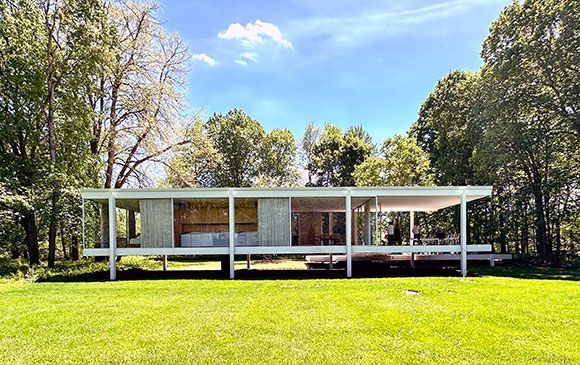
Mies's residential work in America reached its purest expression in the 1951 Farnsworth House located in Plano, Illinois. Elevated above a floodplain on slender steel columns, the house is essentially a glass box floating in a meadow. Interior and exterior merge completely so the surrounding trees and sky become the walls. The Farnsworth House remains one of the most iconic homes ever built, a touchstone for architects and homeowners who believe that a dwelling should connect its inhabitants to the natural world rather than shut it out.
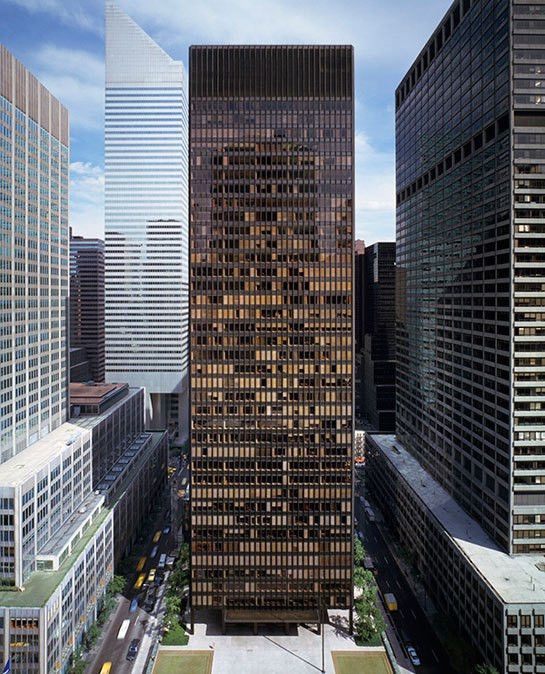
At the urban scale, Mies's Lake Shore Drive Apartments in Chicago and the Seagram Building in New York City established the steel-and-glass curtain wall as the dominant language of the modern skyscraper. The Seagram Building, with its bronze mullions, travertine lobby, and generous public plaza, set a standard of corporate elegance that countless towers have aspired to ever since.
The Pacific Northwest Connection
Though Mies van der Rohe never built in the Pacific Northwest, his influence on the region's residential architecture is profound. Our Northwest Modern style owes an enormous debt to Mies's pioneering work. When a home in Portland or Seattle features walls of glass that dissolve the boundary between a living room and a forested hillside, it is echoing principles Mies championed decades earlier in Barcelona, Brno, and Plano.
His insistence on "less is more" and letting steel columns, wood beams, and concrete surfaces speak for themselves aligned naturally with the Pacific Northwest's tradition of celebrating raw, regional materials like Douglas fir, western red cedar, and exposed concrete. And his conviction that architecture should serve the inhabitant's experience of light, space, and nature finds its fullest expression in a region defined by dramatic landscapes, shifting skies, and a culture that prizes the outdoors.
Ludwig Mies van der Rohe died on August 17, 1969, in Chicago. He left behind a body of work that proved simplicity is not emptiness. Simplicity is pure design and is discipline, refinement, and focus on what matters most. For anyone designing, building, or dreaming of a modern home in the Pacific Northwest, Mies's vision remains as vital and instructive as ever. We strip away the unnecessary, use local materials, open walls to the world outside, and trust that in architecture, as in life, less truly is more.
