The Influence of Japanese Design on Northwest Contemporary Architecture
By Brian Enright
If you've ever walked through a mid-century home in Portland or Seattle and felt an unusual sense of calm you were likely responding to something with very deep roots. The architecture of the Pacific Northwest, particularly the residential style that emerged after World War II, owes a profound debt to the design traditions of Japan.
Geography and immigration has something to do with it but it's not the sole reason. Think about the similar landscapes the two regions share and it starts to make sense. We share steep, forested terrain, temperate but rain-heavy climates, and a building culture shaped by an abundance of wood. So when architects in the Pacific Northwest began searching for modern inspiration in the 1930s and 1940s, they found that Japanese builders had already solved many of the same problems.
Shared Ground
The conversation between Japanese and Northwest design begins with the land itself. Both regions are defined by mountains, dense forests, and a climate that alternates between long stretches of overcast skies and moments of transcendent natural beauty. In both places, wood is the native building material, and the relationship between a structure and its site has always been treated as something close to sacred.
Traditional Japanese architecture evolved under specific constraints. Earthquake risk demanded light, flexible timber framing. Heavy seasonal rains called for broad, overhanging rooflines. The result was a building tradition defined by
post-and-beam construction, deep eaves, sliding screens, and an invitation to bring the outside in.
The Architects Who Listened
Frank Lloyd Wright was himself deeply shaped by Japanese aesthetics. He first encountered Japanese design at the 1893 Chicago Columbian Exposition, became a collector of ukiyo-e woodblock prints, and visited Japan multiple times between 1905 and 1922. He admired what he called the "organic character" of Japanese art. His ideas about organic architecture filtered directly into Pacific Northwest design.
In Oregon, the pioneers of the regional style carried that thread further. John Yeon, the largely self-taught designer whose celebrated 1937 Watzek House helped establish Northwest Modernism on the national stage, was a passionate collector of Asian art. His buildings were described by historians Gideon Bosker and Lena Lencek as unfolding on the landscape "like the painted panels of a Japanese screen." His contemporary, the Italian-born architect Pietro Belluschi, was equally drawn to Japanese precedents. His 1938 Sutor House is widely recognized for combining Pacific Northwest Regionalism with Japanese minimalism. Belluschi befriended a prominent Japanese landscape architect while lecturing at the University of Oregon, and that relationship deepened the Asian influences visible throughout his work, from curving wooden gates reminiscent of temple architecture to woven wood ceilings of extraordinary craft.
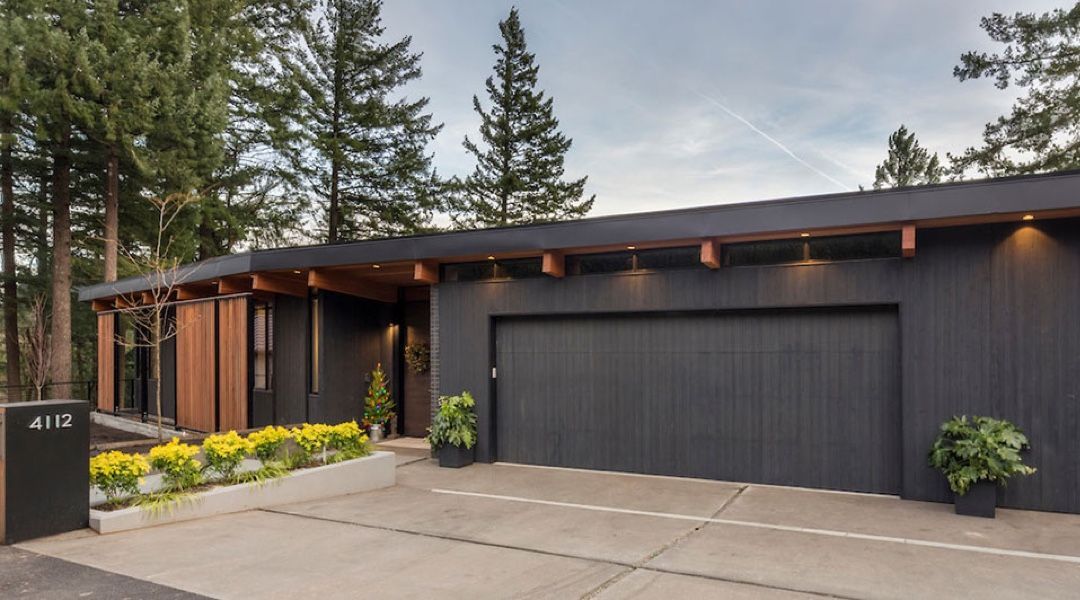
Saul Zaik, the next generation's most prolific residential architect in Portland, carried these ideas forward into the 1950s, '60s, and '70s. His homes, with their floor-to-ceiling windows, exposed beam ceilings, and asymmetrical plans nestled into forested hillsides, spoke a language simultaneously modern American and unmistakably informed by Japanese spatial sensibilities. The same can be said of William Fletcher, Van Evera Bailey, John Storrs, and Paul Hayden Kirk in Seattle.
Even
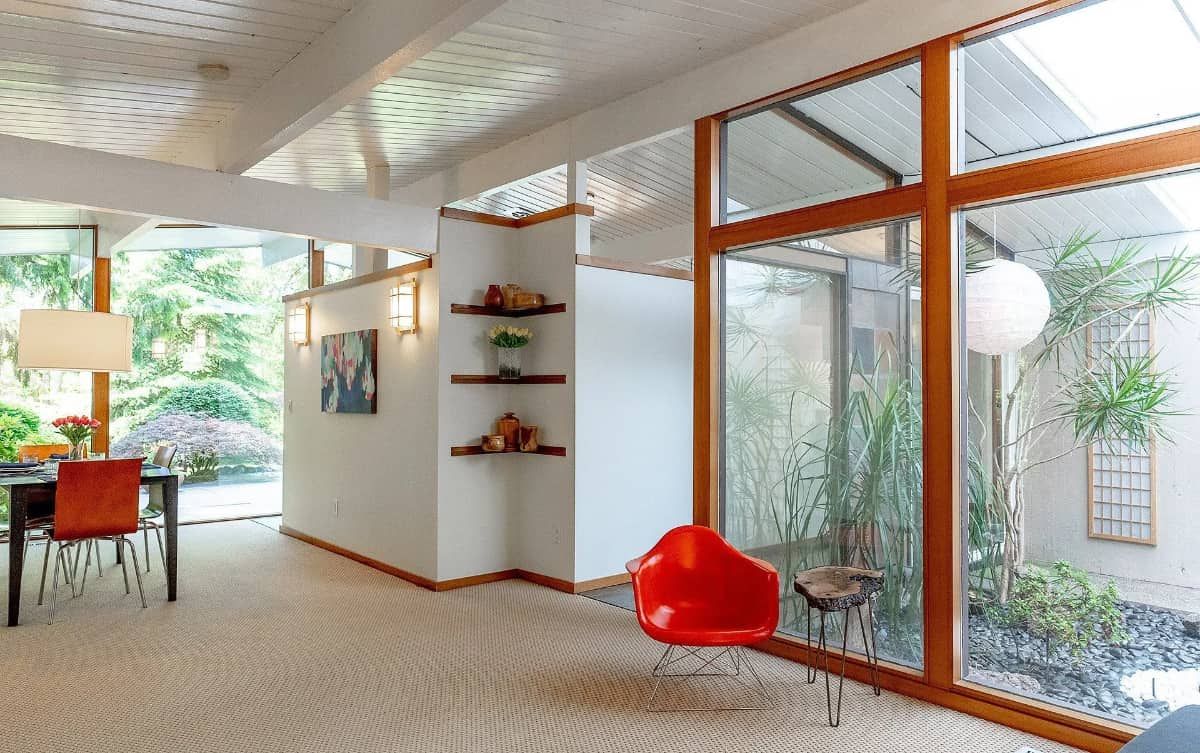
Robert Rummer, the developer who brought modern design to middle-class Portland families, felt the pull. Rummer homes are known for their interior atriums, their integration of indoor and outdoor space, and their nods to Japanese garden design. Some homeowners have replaced suburban lawns with Japanese maples, mugo pines, and stone gardens. That's a Rummer home in the banner above showing a Japanese garden.
The Japanese Principles That Endure
What makes the Japanese influence on Northwest architecture so enduring is that it operates at the level of principle, not decoration. It is not about just installing shoji screens and tatami mats in a house, as much as we like them. Let's review what it really means.
Primacy of natural materials
In both traditions, wood is not concealed behind drywall or paint. It is exposed, celebrated, and allowed to age. Cedar, fir, and hemlock are treated as defining elements of a home's character, not structural necessities to be hidden.
Removing boundaries between inside and outside
Floor-to-ceiling glass, covered walkways, interior courtyards, and carefully framed views all serve the same purpose: making the experience of being in a building feel continuous with the experience of being in nature.
Structural clarity
Japanese architecture insists that you should be able to understand how a building is made by looking at it. Post-and-beam construction, exposed joinery, and visible roof structures all express this value. Northwest architects adopted the same ethic, rejecting concealed framing in favor of an architecture that wears its bones on the outside.
Restraint
This may be the most difficult to achieve, as some homebuilders want to give the client more than they asked for and they do it by adding unnecessary design. But the Japanese concept of ma, the meaningful use of empty space, finds its echo in the spare interiors and uncluttered sight lines of Northwest homes. What you leave out of a design matters as much as what you put in.
A Living Tradition
These principles have had an indelible effect on Portland, and continue to shape the homes being built and restored across the Pacific Northwest. The Portland Japanese Garden, with its Cultural Village designed by architect Kengo Kuma, stands as a living testament to the depth of this cross-Pacific exchange. And who doesn't love seeing the Cherry Blossoms bloom along the Willamette each spring?
Understanding this lineage can add a greater appreciation of the architecture for anyone considering a mid-century or Northwest contemporary home here in Portland. These homes are the product of a decades-long conversation between two cultures that, separated by an ocean, arrived at remarkably similar conclusions about how we can and should live among trees, rain, and mountains.
Recent Posts